Tricked by the Tangible: Why Surface Success Misleads Us
We're often fooled by tangible results. Real success hides in the unseen. Learn to look deeper and find what truly drives meaning and fulfillment.
I suspect we all know someone who claims expertise in something in which they don’t have any first-hand experience. The fantasy football expert who’s never played at nearly a pro level. The day trader or consultant who’s never worked in an operating business. This tendency to confuse tangible abstractions for fundamental meaning shapes how we evaluate success, make decisions, and structure our lives.
This pattern flows directly from our Core Belief about Distilling Essentials — we naturally overvalue what’s tangible and vivid relative to what is intangible but essential. The challenge isn’t to eliminate ambiguity in favor of false certainty, but to develop mental models that are appropriately predictive and efficient.
Key Benefits of the Exercise
01
Builds deep, meaningful connections among team members
02
Provides context for individual behaviors and motivations
03
Encourages vulnerability and trust
04
Fosters empathy and understanding
05
Creates a more supportive and inclusive work environment
Pattern-Seeking Creates Systemic Blindness
1: The Measurement Trap
Our minds constantly seek patterns to navigate complexity. As Daniel Kahneman’s research on System 1 and System 2 thinking reveals, we’re wired to favor “cognitive ease,” quick, intuitive judgments based on what’s immediately visible and measurable.
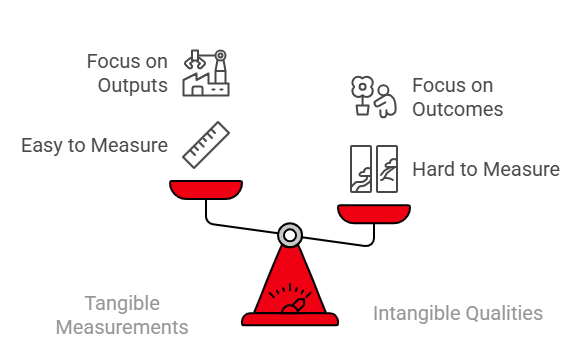
This cognitive tendency shapes much of how we think and act — our minds naturally gravitate toward what we can easily quantify and compare. Revenue numbers, social media followers, championship rings — these concrete metrics become our default measures of success.
2: The Hidden Cost of Metrics
This bias runs so deep that organizations and individuals often reshape their behavior to improve what’s measured, even when those measurements miss the heart of what matters. Companies optimize for quarterly earnings at the expense of long-term innovation. Schools focus on standardized test scores rather than developing genuine curiosity and learning skills.
Organizations promote their best individual contributors to management roles, missing that leadership requires an entirely different skill set.
Free Tool: Define Your Core Values Ready to discover the values that drive your best decisions? Use our free guided exercise. Define your values →
The Complexity Behind Success
3: Beyond Visible Achievements
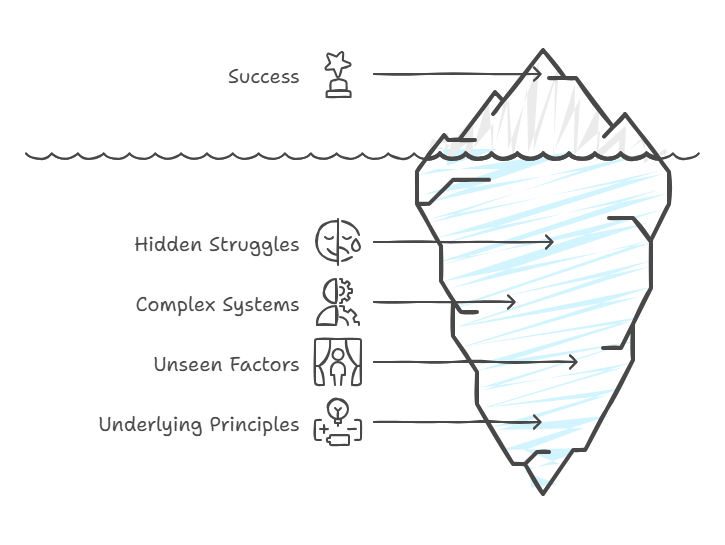
Behind every visible achievement lies an invisible iceberg of decisions, trade-offs, and consequences. The successful entrepreneur’s wealth masks years of grinding uncertainty, strained relationships, and failed attempts.
The star athlete’s trophies don’t show the childhood sacrifices, chronic injuries, and missed life experiences. By fixating on the tangible outcomes, we create oversimplified stories that ignore the rich complexity of real success.
4: The Deception of Surface Understanding
Take the portrayal of professional life in media — if someone pursued a legal career based on TV dramas like LA Law, they’d be in for a rude awakening when faced with the reality of endless document review and routine paperwork. It’s the same with relationships — couples might pursue picture-perfect weddings while neglecting to build the foundation for a lasting partnership.
These shortcuts are seductive because they make complex decisions feel manageable, but they often lead us to optimize for the wrong things. We chase the visible markers of success while missing the invisible qualities that sustain it.
The False Promise of Action
Seek first to understand
The old wisdom “Don’t Just Do Something, Stand There!” challenges our reflexive urge toward action. Most systems exist in natural equilibrium — if something appears broken, we’re likely missing crucial context.
Consider how environmental scientists navigate this tension. While climate data provides crucial metrics, the underlying systems involve complex interactions between ocean temperatures, atmospheric conditions, and countless other variables.
The cost of rushed response
Our bias toward action often prevents us from seeing deeper patterns and equilibriums. We trust that models must be accurate because “numbers can’t lie,” but we ignore the potential compounding of tiny biases in the scientists, institutions, and funding structures behind them.
Even well-intentioned research involves countless assumptions in data collection, sampling, and analysis. The goal isn’t certainty — it’s progress.
Breaking Free from Labels
The trap of categories
When we name something, we give it the power of tangibility. “Success,” “leadership,” “intelligence” — these labels help us process complex concepts but can also trap us in rigid thinking.
By turning fluid realities into fixed categories, we risk missing the nuanced ways these qualities actually manifest. A brilliant engineer might score poorly on IQ tests. A natural leader might never hold a management title.
Experience reveals reality
The antidote to being tricked by the tangible is direct experience that reveals system complexity. Internships show aspiring professionals the unglamorous reality of dream careers.
Mentorship helps rising leaders understand the personal costs of advancement. Deep engagement with any field eventually reveals that the most meaningful aspects often resist simple measurement.
The Path Forward
Moving past the tyranny of the tangible means developing new ways of seeing — learning to value what we can’t easily measure like joy, growth, balance, and impact. While tangible markers serve as useful tools, true success lies in understanding the systems beneath them and building lives that are genuinely fulfilling rather than just measurably successful.
The path forward isn’t about abandoning measurement — it’s about developing a more sophisticated relationship with it. We need models that help us estimate and adapt rather than predict and control. This means embracing appropriate levels of ambiguity, recognizing when to seek more precision and when to trust broader patterns. Most importantly, it means learning to identify and cultivate the essential qualities that create real value, even when they can’t be easily quantified.
Consider data science work — while the outputs might be clean visualizations and precise metrics, the real expertise lies in understanding which questions to ask, what data to trust, and how to account for systemic biases. The tangible outputs mask the intangible wisdom required to produce meaningful insights. This pattern repeats across fields — the things we can measure most easily are often the least important, while the things that matter most resist simple quantification.
By understanding these dynamics, we can build better models of reality — ones that capture the essential qualities that create value while avoiding the seductive oversimplification of pure measurement. This more nuanced approach allows us to navigate complexity more effectively, make better decisions, and create more meaningful success.
Writer and contributor at Love Not Fear, exploring self-leadership, motivation, and values-driven living.
More from Evan →Prefer listening? The Love Not Fear podcast covers these ideas and more.
Listen to the podcast →Keep reading