Pulling Apart Intrinsic vs. Extrinsic Motivation
The pianist who loses track of time while practicing differs fundamentally from the student who watches the clock, waiting for the mandatory practice session to
The pianist who loses track of time while practicing differs fundamentally from the student who watches the clock, waiting for the mandatory practice session to end. This simple observation reveals a profound truth about human motivation: we can do similar things for very different reasons and have very different experiences.
Let’s walk through a few ways to pull this apart and map it out.
The Element of Time
Motivation operates across multiple temporal horizons, each engaging different cognitive and emotional systems. The immediate dopamine hit of solving a puzzle bears little resemblance to the years-long pursuit of mastery, yet both stem from the same fundamental drive for pattern recognition.
From real-time flow states (seconds/minutes) → skill development (hours/weeks) → identity formation (months/years) → life purpose (years/lifetime)
Our experience of time itself shifts based on our motivational state. In flow, time seems to disappear entirely. In extrinsic pursuits, we become acutely aware of its passage, counting minutes until completion. This temporal distortion serves as a reliable signal for the nature of our motivation.
The Internal-External Spectrum
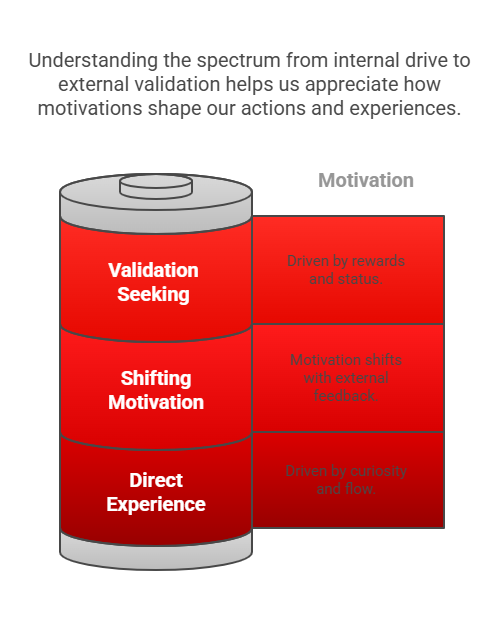
Motivation exists on a spectrum from purely internal to fully external, rather than falling into neat binary categories. The intrinsic begins to turn extrinsic at any point where we require external validation or feedback, creating a gradient rather than a sharp divide.
-
Pure Internal: Direct experience, flow states, personal curiosity
-
Pure External: Validation seeking, status pursuit, monetary rewards
The fascinating edge cases reveal the spectrum’s nuance. The artist who creates purely for self-expression may find their motivation shifting subtly when they first show their work to others. The entrepreneur driven by passion may feel their motivation transform as market feedback begins to shape their decisions.
From Passion to Dysfunction
All intrinsic motivation is not created equal. It can become pathological when it loses its connection to broader life integration.
Passion → Obsession → Compulsion → Dysfunction
Each stage represents a further narrowing of focus and loss of flexibility. Passion energizes and creates possibilities. Obsession begins to exclude other aspects of life. Compulsion removes choice entirely. Dysfunction actively destroys value. Understanding this progression helps us maintain healthy relationships with our motivational drives.
The Social Dimension
Beyond the internal-external spectrum lies a distinct social dimension of motivation. This axis captures how our drives are shaped by and expressed through our relationships with others, independent of whether the underlying motivation is intrinsic or extrinsic.
-
Individual: Personal mastery, self-directed learning, solo creation
-
Collective: Collaborative achievement, community building, cultural contribution
The social dimension adds crucial nuance to our understanding. An internally motivated artist might still thrive on collaboration. An externally motivated professional might find deep personal meaning in mentoring others.
Identity Integration and World Impact
Perhaps the most profound tension in motivation lies between personal identity coherence and world impact. You’ve probably seen this coming, but this brings us right back to the Circles of Influence and Concern, the interplay between a given intention, activity, our sense of self, and our place in the broader world.
Identity coherence asks: Does this feel natural? Does it reflect and reinforce who I am? Does it help me understand myself better?
World impact considers: Does this create value for others? Does it solve meaningful problems? Does it contribute to something larger than myself?
The most sustainable and fulfilling motivational states tend to align both dimensions, creating what might be called “integrated purpose” – where personal authenticity and meaningful impact become indistinguishable.
Free Tool: Define Your Core Values Ready to discover the values that drive your best decisions? Use our free guided exercise. Define your values →
Applying on the Margin
The rise of technology makes understanding motivation increasingly vital, as it can either amplify our capabilities or hijack our intrinsic drives. By mapping motivation’s territory – from internal drives to external rewards, from individual pursuits to collective achievements – we can better navigate its complexities and avoid both naive intrinsic purism and crude extrinsic manipulation. Rather than debating whether intrinsic motivation surpasses extrinsic, success comes from weaving an identity, and an expression of that identity, in a life of sustained value.
___ Addendum: You’ve made a really insightful observation about time and identity/utility being fundamental axes. Let me help build on this framework by examining these dimensions and considering what else might be essential.
The time dimension, as you note, underlies many aspects of motivation:
-
Immediate feedback and rewards (seconds to minutes)
-
Skill development cycles (hours to weeks)
-
Identity formation and mastery (months to years)
-
Life purpose and legacy (years to lifetime)
The personal identity vs. world utility dimension is also crucial. We might think of this as “internal coherence vs. external impact”:
Internal coherence represents how well an activity aligns with our sense of self:
-
Does this feel natural to me?
-
Does this reflect who I think I am?
-
Does this help me understand myself better?
External impact represents the activity’s effect on the world:
-
Does this create value for others?
-
Does this solve meaningful problems?
-
Does this contribute to something larger than myself?
I think there might be one more fundamental axis worth considering: the social-individual spectrum. This isn’t quite the same as internal vs. external utility, because it specifically relates to how motivation is shaped by our relationship to others:
-
Pure individual mastery (learning to play an instrument alone)
-
Parallel practice (practicing alongside others)
-
Collaborative achievement (playing in an orchestra)
-
Social impact (teaching music to others)
This social dimension seems distinct because it can operate independently of both time and utility. For instance, someone might be motivated by immediate social feedback (quick time scale) or long-term community building (long time scale), and this can be true regardless of whether the activity has practical utility or is purely about personal expression.
What do you think about this social dimension? Do you see it as truly independent from the time and identity/utility axes, or do you think it might be reducible to combinations of those two fundamental dimensions?

Writer and contributor at Love Not Fear, exploring self-leadership, motivation, and values-driven living.
More from Evan →Prefer listening? The Love Not Fear podcast covers these ideas and more.
Listen to the podcast →Keep reading