People, Process, Product, Profit: A Simple Growth Guide
Learn how People, Process, Product, and Profit work together to spark value, drive growth, and build a thriving business.
The foundation: What drives team engagement
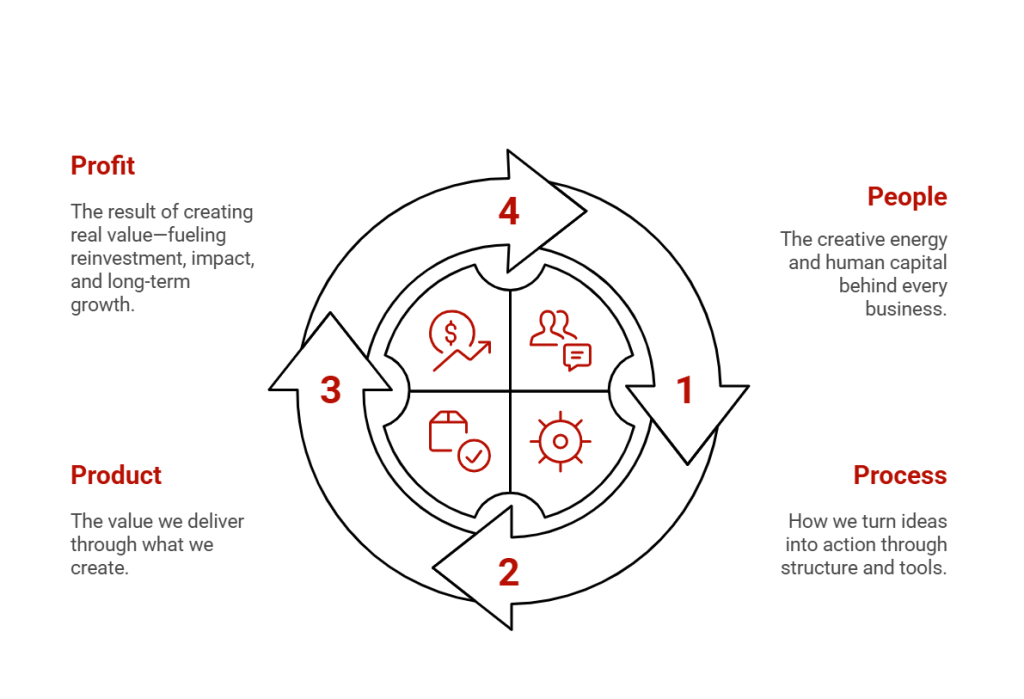
The People, Process, Product, Profit framework maps the key inputs, outputs, and value stream of a business. It illustrates how we spark energy, where it’s channeled energy, and how we create value for all involved.
- Our inputs are People and Process. People are the fundamental resource. Process includes all of the materials, tools, and ingenuity that we organize.
- We combine them into a product (or service), some value-added unit that we provide to customers.
- If the customer values it (the “value add” part) more than it costs us to make, we create surplus. Value creation = energy amplification!
The Framework
1: People
People are the foundational source of value in a business. No other asset has value outside of the team’s ability to leverage it. A team contributes creativity and labor, and they receive a mix of tangible (pay) and intangible (mastery, belonging, purpose…) compensation.
Customers and suppliers have more transactional relationships, but all involve short-term transactions and long-term investments, like recruiting, prospecting, and development. Each business offers its own unique mix of these foundational resources.
2: Process
Process is HOW we leverage resources and activities to create value. It’s the balance of standardization and innovation. Without consistency, we’re improvising and fire fighting.
Standardization can turn grooves into ruts or allow us to run experiments that lead to breakthroughs. It’s the cliched “working IN the business working ON the business.” The short-term pays the bills, but investments in productivity and infrastructure generate compounding returns over time.
3: Product
Product is the result of combining People and Process into something others value. How much we focus on creation versus refinement depends on the stage of the business and maturity of the industry. All energy may be focused on creating a start-up’s better mousetrap.
A mature business may be focused on leveraging the brand, squeezing efficiency, and cultivating intangibles. The bottom line is turning our inputs into something that customers will pay for.
4: Profit
Speaking of bottom line, if we sell something for more than the sum of its parts, we create surplus that keeps the cycle going. It provides rewards to share and savings for a rainy day. It lets us make and keep promises and reinvest in longer-term bets. It’s the scoreboard that tells us we’re creating genuine value or just treading water.
Free Tool: Join the Inner Circle Go deeper with a community of leaders committed to love-based leadership and organizational change. Learn more →
Finding Harmony
With finite resources, the way we allocate our attention across these four areas defines who we are as an organization. We can’t be absolutely people-focused, for instance, if we’re not generating profit to make payroll.
The goal isn’t to solve this like an equation with a single answer. It’s about understanding our unique assets and leveraging them to find the fit in the market that creates the biggest win-win.
Key Benefits of the Exercise
01
Clarifies the business value stream
02
Aligns team focus
03
Supports strategic decision-making
04
Links effort to outcome
05
Encourages holistic thinking
Writer and contributor at Love Not Fear, exploring self-leadership, motivation, and values-driven living.
More from Evan →Prefer listening? The Love Not Fear podcast covers these ideas and more.
Listen to the podcast →Keep reading