CAMP: Connection, Awareness, Mapping, Practice Framework
Discover how CAMP helps build trust, sharpen focus, simplify learning, and turn small daily actions into lasting personal and team growth.
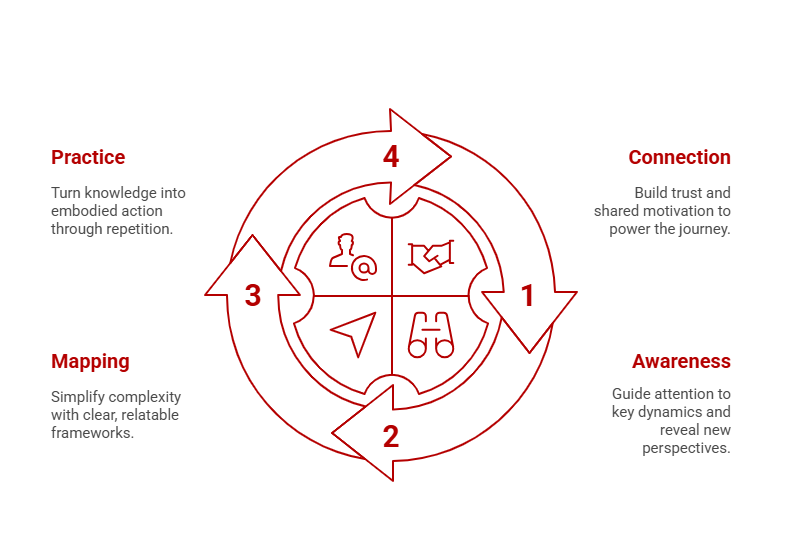
CAMP is our foundational framework for both learning and change management. We group these together, because we believe that both should be judged by behavioral impact not information accumulation. This higher standard forces us to slow down and focus on the sources of highest leverage, sparking individuals’ curiosity and creating ongoing communities of practice.
- Connection: Build trust and shared motivation
- Awareness: Guide attention to relevant dynamics
- Mapping: Share simplifying, relational frameworks
- Practice: Repeat behaviors in context
Most academic and corporate training share a “more is more” approach even though universal experience proves that audiences zone out after about 20 minutes and max their mental bandwidth at 4 to 7 “chunks” of new information. Forming new habits or gaining a new skill is more like a child learning to walk or the journey to master a sport. It’s messier and takes longer than we’d like.
It’s just like getting fit. You’re guaranteed to get stronger from daily pushups, but only monthly sessions from a personal trainer won’t get you anywhere. The small gains compounds, and the deepest rewards pop up along the way.
Connection: A Two-Part Foundation
Think about how different you would feel in these two scenarios:
- After two years at a job, some consultant comes in and tells you how to rework your whole process
- A star performer, who you’ve long admired, from another department approaches you and suggests you should grab a coffee to “compare notes”
Those different levels of defensiveness and excitement reveals the first principle of learning, Connection before Content. Here are a few keys to establishing this foundation of Trust and to create Safe Space for Risk Taking:
- Respect: understand each other’s broader circumstances, values, and prior knowledge
- Credibility: demonstrating competence and reliability
- Alignment: clarify that goals and motivations are aligned or complementary
Once the door is opened, the second pillar is understanding Energy Systems: how to spark curiosity and sustain the motivation to keep learning and growing:
- Sources: complementary skills, hobbies, pain points… or just fun
- Amplifiers: balancing autonomy and group alignment
- Frictions: fear, competing priorities, or misaligned incentives.
- Goals: clear pathways to meaningful, achievable milestones
When connection is strong, the power supply is hooked up. Everything else flows.
1: Awareness: Focusing the Spotlight
Our minds are efficiency-seeking machines, and we create filters for the constant flood of stimuli around us. Often, the highest leverage for change comes simply from making sure we’re seeing the right dynamics on the right level.
The subconscious area of our mind is millions of times more powerful than the conscious. We can’t possibly instruct all the details of complex behaviors. Instead, the key is getting the subconscious spotlight on the right elements and letting it naturally integrate changes in ways that fit with existing patterns.
Think about trying to change your golf swing or tennis serve. You’ve built years of muscle memory and neural pathways. Even if you intellectually understand the new technique, you can’t pass those directions to every muscle every millisecond. This is the gap between knowing and doing, and the subconscious is the only way to bridge it. The same is true for intellectual change. We can’t update our whole computer’s operating system by writing it an email.
Effective coaches understand this reality. They focus you on key reference points that allow your subconscious to naturally find harmony across the system:
- Focus: Directing attention to the right level of detail at the right time
- Relevance: Connecting new information to existing frameworks and priorities
- Timing: Introducing changes when the system is receptive and ready
- Framing: Presenting information in constructive, actionable chunks
The real bottleneck in change isn’t information availability, it’s attention. Where we focus determines what we can improve.
Free Tool: Join the Inner Circle Go deeper with a community of leaders committed to love-based leadership and organizational change. Learn more →
2: Mapping: Creating Useful Structures
Once everyone is focused in the same direction, it becomes a rewiring challenge. By adulthood, we’ve built a dense web of mental frameworks and identity. That much “software” takes substantial energy to update, which is why we often plateau and avoid the messy work of meaningful change. Mapping embraces this reality. It provides the shortcuts our brains crave, frameworks and structures that help weave in and layer on new ideas
- Simplifying Complexity: Breaking things down into manageable chunks and relationships
- Creating Common Language: Leveraging shared terms, symbols, and metaphors
- Providing Reference Points: Clear starting points for practical application
- Accommodating Preferences: Offering multiple formats that engage all the senses and work with different learning styles
Maps aren’t just handed over—they’re demonstrated. People need to see what “good” looks like through practical examples and the facilitator’s consistent modeling of behavior that’s consistent with the teachings. This engages all the senses and activates the subconscious to accelerate absorption.
In today’s information-saturated world, content is a commodity. It’s usually better to offer something “good enough” that actually gets used than something comprehensive that sits in a drawer. Chasing ultimate expertise may come later. The best maps should lighten your mental load and keep you pointed in the right, general direction. You’ll figure out the details once you get rolling.
3: Practice: Embodiment Through Repetition
Practice is where the rubber hits the road and potential becomes capability. Like building doing those pushups, meaningful change requires repeated application over time. There are no shortcuts here. Real change is going to be messier and take longer than you think, but the process is also going to forge team connections and unlock hidden opportunities.
Effective practice has several key elements:
- Achievable Challenge: not so easy it’s effortless; not so hard it’s hopeless
- Authentic Context: as close to real situations as possible; bad simulations are better than classrooms
- Five Senses: engage all the senses (seeing, hearing, doing…) and learning styles
- Actionable Feedback: quick tips on what’s working and what can be enhanced
- Repetition: regular opportunities to reinforce, extend, and explore
- Reflection: creating space to process and make meaning of what’s been learned
- Autonomy: solicit input and set parameters, not instructions, for how people engage
The efficiency of practice depends greatly on the quality of the previous CAMP elements. Practice without connection lacks energy. Practice without awareness lacks focus. Practice without good maps lacks direction.
The facilitator’s role isn’t to force change like a mechanical system but to build environments of trust and experimentation. This mindset shift recognizes that our job is to cultivate rather than control. What looks like resistance often signals untapped potential. Organizations thrive when they amplify natural energy rather than try to manage it.
Key Benefits of the Exercise
01
Drives behavioral change, not just knowledge gain
02
Builds trust and engagement first
03
Guides attention to what matters most
04
Simplifies complex ideas through mapping
05
Turns insight into action through practice

Writer and contributor at Love Not Fear, exploring self-leadership, motivation, and values-driven living.
More from Evan →Prefer listening? The Love Not Fear podcast covers these ideas and more.
Listen to the podcast →Keep reading