The Two by Four: Beliefs-Behaviors Matrix
Learn how beliefs shape behaviors across teams, culture, and markets — spot misalignments and create harmony with this simple matrix.
The Beliefs-Behaviors Matrix framework reveals how inner beliefs cascade into external behaviors across every level of an organization. It provides a diagnostic map for finding sources of harmony to amplify and pinpointing misalignments that create friction.
Stepping Back: Two Foundational Pillars
1: Feedback Loops
Every behavior begins as a belief-based hypothesis. As we act, we’re constantly adjusting based on feedback — a ball’s trajectory might influence our next throw, while a failed business decision might reshape an entire strategy.
Either way, results loop back into our belief system, creating continuous cycles of learning and adaptation.
2: One to Two Dimensions
The human mind’s urge for efficiency often overshoots to oversimplification. Complex dynamics with multiple variables and sequences get dumbed down to unrealistic binaries: good vs. bad or cause and effect.
Rarely is anything interesting that simple. The first step to break away from binary thinking is to introduce a second variable. A 2x2 matrix allows us to isolate how different combinations may play out into four distinct quadrants. It doesn’t capture second-order effects or outside factors, but it’s a start down the path of mapping greater nuance and relational richness.
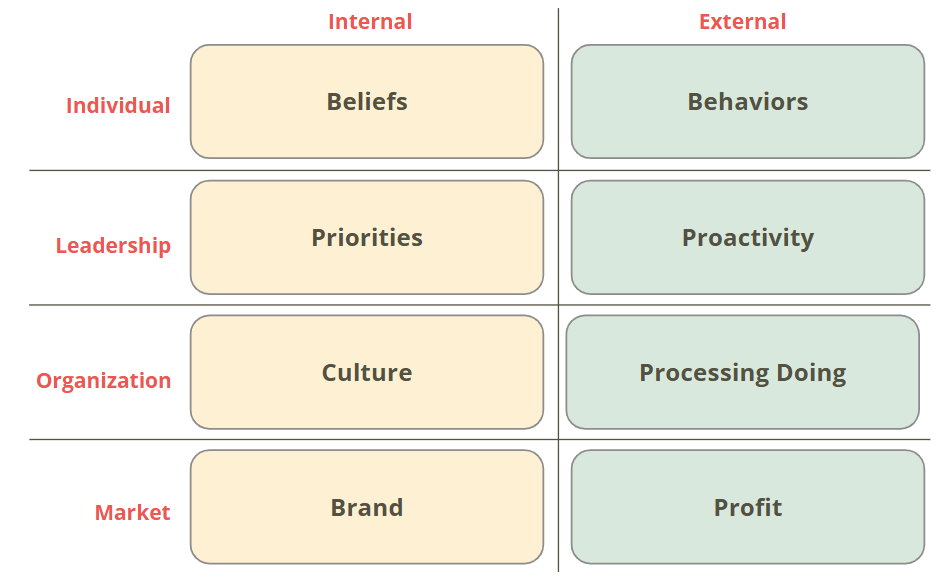
The Beliefs-Behaviors Matrix adds a waterfall of two more layers that unfold in a 2x4 as follows:
- Internal Beliefs vs. External Behaviors: What happens inside (invisible) versus what manifests outside (observable)
- Layers of Individual, Leadership Team, Company, and Market: How dynamics flow from personal to collective levels
Free Tool: Join the Inner Circle Go deeper with a community of leaders committed to love-based leadership and organizational change. Learn more →
The Matrix Decoded
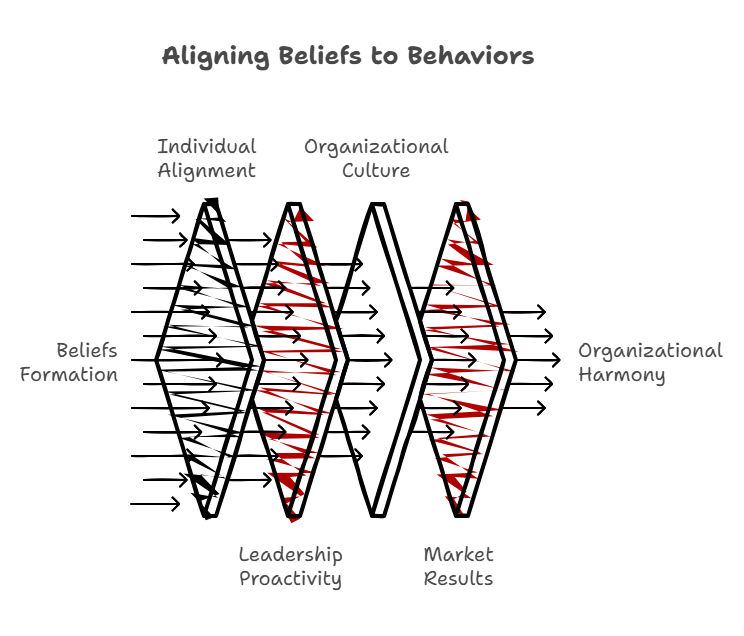
This pattern ripples from individuals through leadership, across organizations, and ultimately into market results. Each level creates its own internal-to-external dynamics while also influencing the levels below it. When analyzed systematically, this reveals where energy flows smoothly and where it gets blocked.
Let’s explore how this unfolds at each layer:
1: Individual Level: Beliefs -> Behaviors
What begins as a personal philosophy transforms into daily habits and actions. Alignment here determines whether someone is energized or drained by their work.
When individuals are well-aligned at this level, they naturally seek alignment with leadership priorities.
2: Leadership Level: Priorities -> Proactivity
Leaders translate vision into exemplary practices. When priorities align with actions, teams gain clarity and momentum.
When they don’t, confusion reigns. Well-aligned leadership teams naturally work to coordinate with the broader organization.
3: Organization Level: Culture -> Process
What we value collectively shapes our systems and structures. Culture isn’t just what we say we value — it’s what our processes actually reward and enable. Organizations in harmony at this level naturally focus on closing gaps with market needs.
4: Market Level: Brand -> Profit
Our reputation and promises meet reality in the marketplace. Customers experience the culmination of all previous alignments or misalignments through every interaction with our products and services.
5: Finding and Fixing Misalignments
Most organizational friction stems from gaps between what we say and what we do. Instead of addressing symptoms, this framework lets us trace issues to their source if:
- Individuals act contrary to stated values, do they truly understand and embrace those values?
- Leadership priorities rarely translate into action, are they realistic or merely aspirational?
- Processes contradict cultural values, which should change?
- Market results disappoint, where did the alignment break down?
6: Creating Harmony
A healthy organization achieves vertical and horizontal alignment across the matrix. When this happens:
- Individual: Behaviors naturally express their beliefs
- Leadership: Practices embody their stated priorities
- Organization: Processes reinforce cultural values
- Market: Results reflect authentic brand promises
7: Practical Application
Rather than treating problems in isolation, this framework helps us see interconnections. Before jumping to solutions, we ask better questions:
- Do we have the right vision at each level?
- Are our behaviors consistent with our beliefs?
- Where are the misalignments creating friction?
- Which interventions would create the highest leverage?
By mapping these dimensions, we move beyond simplistic fixes to address the system as an integrated whole — acknowledging that organizational health flows from the inside out and from the top down.
Key Benefits of the Exercise
01 — Reveals root causes of misalignment
02 — Connects inner beliefs to external outcomes
03 — Encourages systemic thinking
04 — Promotes organizational integrity
05 — Guides high-leverage interventions
Writer and contributor at Love Not Fear, exploring self-leadership, motivation, and values-driven living.
More from Evan →Prefer listening? The Love Not Fear podcast covers these ideas and more.
Listen to the podcast →Keep reading