Alignment, Trust, and Motivation in Systems
The ATM method is a systemic framework for understanding how belief structures shape behavior — individually and organizationally.
The Foundation: Beliefs Drive Behaviors
Taking a systems view of the world, we can observe that beliefs inherently drive behaviors — nothing remains static for long. This relationship is almost definitional: if someone believes they need food to eat, they will naturally seek food. The belief structure makes certain behaviors inevitable at a broad level.
When an individual’s beliefs are aligned, they consistently drive behaviors toward whatever cause and effect is determined by those beliefs. This principle extends to team dynamics in powerful ways.
Team Alignment and Action
At the team level, alignment means having common or complementary beliefs. For example, team members might share beliefs that:
- There is a market opportunity
- The team has the potential to meet that opportunity
- A specific product or service will satisfy customer needs
Once these aligned beliefs exist, action naturally follows. While there may be practical constraints like time or resources, the system essentially propels itself forward. It’s similar to water flowing downhill — if you dig a trench, the water will simply flow. Similarly, when people identify an unmet need they believe they can fulfill, they will act on it.
The Alignment-Trust-Motivation Triangle
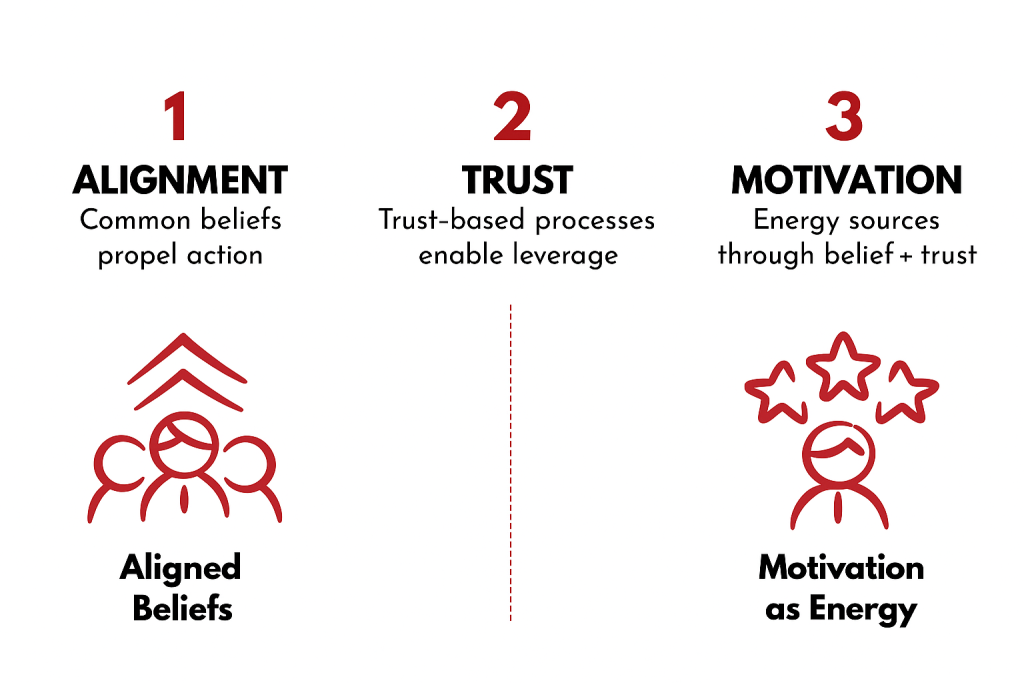
1: Alignment Drives Action
At the foundation, alignment of beliefs naturally creates motivation and drives action. When beliefs are truly aligned, motivation follows automatically — there’s no need to force it. Any apparent resistance would indicate competing beliefs or priorities within the system.
2: Trust Enables Leverage
Trust is what allows the system to scale and build upon itself. Without trust, alignment faces friction. Trust develops through:
- Shared values
- Demonstrated competence
- Clear role definition
- Reliable processes and systems
- Proven track record
When trust exists alongside alignment, it enables leverage at multiple levels:
- Leadership team trust enables organizational leverage
- Internal trust enables operational leverage
- Customer trust enables market leverage
3: Motivation as System Energy
Motivation represents the energy level in the system. The effectiveness of this energy depends on:
- Having the right fuel (aligned beliefs)
- Having the right leverage (trust-based systems)
- Minimizing friction or counterforces
Free Tool: Join the Inner Circle Go deeper with a community of leaders committed to love-based leadership and organizational change. Learn more →
Key Benefits of the Exercise
01
Aligned beliefs naturally drive action
02
Trust enables leverage at every level
03
Behavior reveals belief (What people do is the ultimate evidence of what they believe)
04
Motivation is energy for the system
05
Systemic alignment increases efficiency
Why It Works
The ATM method works because it reflects how beliefs shape behavior, how trust amplifies effectiveness, and how motivation fuels sustained action within aligned systems. Here’s why it’s so effective:
The Reciprocal Nature of Beliefs and Behaviors
While we often emphasize that beliefs drive behaviors, the reverse relationship is equally significant — behaviors define beliefs. Since we cannot fully understand people’s complex psyches and subconscious motivations, examining behaviors provides valuable insight into true beliefs. As the saying goes, “the proof is in the pudding” — what people do is the ultimate evidence of what they believe.
Someone might consciously think they believe one thing while acting differently due to competing commitments or higher-level priorities they may not fully recognize. Their behavior reveals these deeper, sometimes unconscious beliefs that override surface-level stated beliefs.
Organizational Implementation
For a business to function effectively, alignment must exist across multiple dimensions:
- Internal psychological alignment
- Leadership team alignment
- Company-wide alignment
- Structural alignment (processes, frameworks, systems)
These elements don’t require perfect consensus, but they must be complementary. The goal of organization is to align these elements so that action becomes as efficient and effective as possible.
This alignment-trust-motivation framework serves as an analytical tool for assessing system health. By examining these components and their interactions, we can better understand and optimize organizational dynamics.
Writer and contributor at Love Not Fear, exploring self-leadership, motivation, and values-driven living.
More from Evan →Prefer listening? The Love Not Fear podcast covers these ideas and more.
Listen to the podcast →Keep reading